
Captain Thomas Mantell UFO Incident: What Happened?
Captain Thomas Mantell was not searching for a flying saucer when he took off on January 7, 1948.
He was leading a routine flight of Kentucky Air National Guard fighters across the state.
Then radio operators at Godman Army Airfield asked the pilots to investigate a strange object visible over Kentucky.
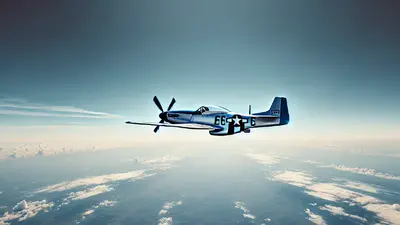
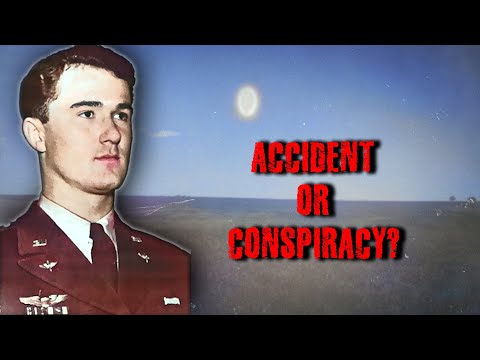
Mantell climbed after it in his F-51D Mustang. Less than two hours later, his aircraft crashed near Franklin, Kentucky, killing him at the age of 25.
The tragedy became one of the first nationally famous UFO incidents in American history.
It also produced a story much stranger than the surviving evidence.
Who Was Captain Thomas Mantell?
Thomas Francis Mantell Jr. was born in Kentucky in 1922.
During World War II, he flew C-47 transport aircraft and participated in major airborne operations in Europe.
Mantell received the Distinguished Flying Cross and other decorations for his military service. He was an experienced pilot, not a reckless beginner.
After the war, he joined the newly formed Kentucky Air National Guard and became a pilot with the 165th Fighter Squadron.
His unit flew the F-51D Mustang, the postwar Air Force designation for the aircraft better known as the P-51 Mustang.
The Strange Object Over Kentucky
The incident began early that afternoon when the Kentucky Highway Patrol received reports of an unusual object in the sky.
The reports moved through police and military channels until they reached Godman Army Airfield at Fort Knox.
Members of the Godman control tower staff soon located the object themselves.
They watched it through binoculars but could not identify it as an ordinary aircraft or familiar weather balloon.
The witnesses did not all describe exactly the same thing.
Some accounts compared it to a white disk or a large circular object. Other descriptions sounded more like a parachute or an ice cream cone with red coloring near the bottom.
Those differences matter.
They suggest the witnesses were looking at something distant, where glare, haze, viewing angle, and suspended equipment could change its apparent shape.
Why Mantell Joined the Search
Mantell and three other National Guard pilots were already in the air when Godman asked whether they could investigate.
One aircraft was reportedly low on fuel and continued toward the field.
Mantell and the remaining pilots turned toward the object and began climbing.
The request made sense at the time. Radar coverage was limited, and sending pilots for a closer look was one of the few ways to identify an unknown object.
There was no indication that the pilots expected to find an alien spacecraft.
They were trying to determine whether the object was a balloon, an aircraft, or something that might threaten restricted airspace.
Mantell Climbs Too High
The pilots followed the object upward, but the climb soon became dangerous.
Their Mustangs were not properly equipped for a prolonged pursuit at extreme altitude.
Mantell's companions stopped climbing and turned back. Mantell continued alone.
He was last known to be climbing through roughly 20,000 feet and may have reached considerably higher.
At those altitudes, a pilot without adequate supplemental oxygen can develop hypoxia.
Hypoxia deprives the brain of oxygen. It can weaken judgment, narrow vision, create false confidence, and eventually cause unconsciousness.
The most dangerous part is that the person experiencing it may not understand what is happening.
What Did Mantell Say on the Radio?
The most famous version of the story says Mantell described a tremendous metallic object before his radio went silent.
That quotation has appeared in books, documentaries, and UFO accounts for decades.
Its origin is uncertain.
Edward Ruppelt, who later led the Air Force's Project Blue Book investigation, wrote that personnel in the control tower could not remember Mantell making the dramatic statement later attributed to him.
The surviving record supports a simpler conclusion: Mantell could see an object, believed he was gaining on it, and continued climbing in an attempt to identify it.
Then radio contact ended.
The Fatal Crash Near Franklin
The evidence indicates that Mantell became disoriented or unconscious after climbing beyond a safe altitude without sufficient oxygen.
His Mustang entered a descending spiral.
As the aircraft fell, aerodynamic forces placed enormous stress on its structure. Parts of the plane separated before it struck the ground on a farm near Franklin.
Mantell did not survive.
Investigators found no credible evidence that another object fired on his plane or physically damaged it.
The crash itself was consistent with a pilot losing control at high altitude.
How a Tragedy Became a UFO Legend
The accident happened only months after Kenneth Arnold's 1947 sighting helped popularize the phrase “flying saucer.”
Public interest in strange objects was already intense.
When a decorated military pilot died while chasing one, newspapers had an irresistible story.
Rumors quickly claimed that Mantell had been attacked by a spacecraft, that his body was missing, or that the wreckage was radioactive.
Other stories described mysterious holes in the aircraft or injuries that could not be explained by the crash.
None of those claims is supported by the documented investigation.
Why the Venus Explanation Failed
One early theory proposed that Mantell and the ground observers had mistaken the planet Venus for an unknown object.
Venus can sometimes be seen during daylight, especially when an observer knows exactly where to look.
But it was not a convincing explanation for the full case.
The reported haze would have made Venus difficult to see, and the witnesses described an object whose appearance and movement did not fit the planet well.
Astronomer J. Allen Hynek, who consulted for the Air Force, later rejected Venus as a satisfactory answer.
The premature explanation damaged public confidence and helped the incident retain its mysterious reputation.
Was Mantell Chasing a Skyhook Balloon?
The strongest conventional explanation is that Mantell was pursuing a large Skyhook research balloon.
Skyhook balloons were part of a high-altitude program developed in the late 1940s. They carried scientific instruments into the upper atmosphere and could rise to approximately 100,000 feet.
These were not small balloons of the kind released by a local weather station.
As their lifting gas expanded at high altitude, some became enormous. Sunlight reflecting from their surfaces could make them appear bright, metallic, or disk-like from the ground.
The equipment suspended below a balloon could also explain reports of a darker or reddish area beneath the main object.
Because parts of the program were not public, the observers at Godman Field may not have known what they were seeing.
Mantell could have climbed toward a balloon that remained thousands of feet above him and appeared almost stationary because of the distance.
Evidence Supporting the Balloon Explanation
The balloon theory is not based only on the object's altitude.
Reports from the region described balloon-like shapes, including a pear-shaped object with cables or equipment hanging below it.
Astronomer Carl Seyfert of Vanderbilt University also reported seeing a balloon-like object south of Nashville that day.
The descriptions of a parachute, cone, or pale circular body with something darker underneath are broadly consistent with a large balloon and its instrument package.
A high-altitude balloon also explains why Mantell could continue climbing without getting close enough to identify it.
Was a Skyhook Balloon Ever Proven?
There is an important limit to the explanation.
No widely available launch record provides a perfect chain of evidence connecting one named Skyhook balloon to every sighting reported across Kentucky that afternoon.
That prevents the case from being closed with absolute certainty.
However, historical investigations do not always preserve the single document that would settle every question.
The balloon explanation fits the appearance, altitude, apparent motion, regional observations, and classified technology of the period better than the alternatives.
It should therefore be described as the most likely explanation, not an unquestionable fact.
Did a UFO Shoot Down Mantell's Plane?
There is no reliable evidence that the object attacked Mantell.
No confirmed weapon damage, unusual radiation, or extraterrestrial material was recovered from the wreckage.
The aircraft's final descent can be explained without adding an attack.
A pilot suffering from hypoxia can lose consciousness while the aircraft continues to climb. The unattended plane may then stall, enter a spiral, gain speed, and break apart under stress.
That explanation is tragic, but it is not mysterious.
Why the Mantell UFO Incident Still Matters
The Mantell incident became a defining case because it joined three powerful elements: a visible unknown object, a military pursuit, and the death of a respected pilot.
It also exposed a problem that would follow official UFO investigations for decades.
Secret government programs could create strange sightings, while the secrecy surrounding those programs prevented officials from giving the public a clear explanation.
When authorities first offered an unconvincing answer such as Venus, suspicion grew.
By the time the stronger balloon theory emerged, the story of a pilot killed by a flying saucer had already entered popular culture.
The National Archives preserves the records of Project Blue Book, the later Air Force program that studied this and thousands of other UFO reports.
What Most Likely Happened to Thomas Mantell?
On January 7, 1948, military and civilian witnesses saw a real object they could not immediately identify.
Mantell climbed after it in an attempt to learn what it was.
The object was most likely a large high-altitude research balloon, possibly connected to Project Skyhook.
Mantell continued beyond a safe altitude without adequate oxygen, became impaired or unconscious, and lost control of his aircraft.
Nothing in the surviving evidence requires an extraterrestrial explanation.
That does not make the story less important.
Thomas Mantell was a decorated veteran who died while carrying out an assignment. The facts deserve to be remembered without the rumors that grew around them.
Recommended