Could Alien Technology Be Hiding in Moon Dust?
- The Moon Has Been Collecting for a Long Time
- Looking for the Remains of a Maker
- How Scientists Would Search Moon Dust for Alien Technology
- Stardust Already Brought Home a Useful Comparison
- One Cubic Meter Is a Very Big Small Sample
- A Tube That Waited Nearly Fifty Years
- Inside NASA’s Lab as a Sealed Moon Sample Is Opened
- Old Dust, New Questions
Could a grain of Moon dust contain a piece of alien technology? A team of researchers wants scientists to look for tiny objects that might have been made by another civilization. Such a piece could be too small to see without laboratory equipment.
Lewis Pinault and his coauthors have proposed the search, but they have not reported finding alien technology. Their idea is to look for physical traces that could remain long after their makers had disappeared. The Moon might preserve such traces, if any reached it and survived.
The Moon Has Been Collecting for a Long Time
The Moon's surface is covered in broken rock and powder called regolith. Repeated impacts smash its rock into pieces ranging from boulders to fine dust.
As NASA's Moon overview explains, the Moon has an extremely thin atmosphere, called an exosphere. Its scarred surface holds clues to its ancient past. But impacts also break, melt and mix the material on that surface.
That matters for a search through old dust. A particle might survive for a long time, while the ground around it changes. Researchers would need to work out what had happened to it since it arrived.
A home telescope can show the Moon's dark plains and bright highlands. Studying the tiny grains within those landscapes would require a close look at samples.

- Find hundreds of night-sky objects with directions designed for home telescopes
- Use observing illustrations to understand what a target should look like through the eyepiece
- Turn an evening under the stars into a planned observing session
Looking for the Remains of a Maker
The SETI Institute's September 2026 announcement describes the proposal as a preprint under review. That means the researchers have shared their paper while it is being considered for publication. Pinault's coauthors include Brian Lacki, Ian Crawford and Andrew Siemion.
The wider SETI search looks for signs of intelligent life beyond Earth. One approach is to listen for radio signals. To catch one, we have to be listening when it reaches us.
A surviving piece of technology could give us more time. Even if its makers were long gone, the material might still be here to study.
But several things would have to happen first. A particle would need to escape the place where it was made and cross the space between stars. Along the way, it could slow down or wear away. It would then have to enter our solar system, hit the Moon and survive being mixed into the surface.
The proposal studies those possible steps. It does not report that any alien-made particle has completed the trip.
How Scientists Would Search Moon Dust for Alien Technology
Stardust Already Brought Home a Useful Comparison
Scientists have already studied tiny particles that probably came from interstellar space, the space between stars. NASA's Stardust mission brought back a collector that had spent 200 days in a stream of dust arriving from beyond the solar system.
In a 2014 study led by Andrew Westphal, researchers identified seven particles that best fit an interstellar origin. They examined images, chemistry and the tracks the particles left in the collector. Laboratory tests and computer models helped them check their explanations.
That work shows how much effort it takes to study a tiny grain. It also shows why a distant birthplace would be only part of the answer. Natural dust travels between stars too. Researchers would still have to show that a particle had been made by technology.
One Cubic Meter Is a Very Big Small Sample
The proposed search uses about one cubic meter of regolith as a reference amount. Picture a cube one meter along each edge. Now imagine checking it for grains measured in millionths of a meter.
The researchers have not completed such a search. Their full preprint says examining all that material at this scale is beyond current laboratory practice. Suitable instruments exist, but preparing and processing so much dust remains a major obstacle.
The plan calls for machines to help sort the grains and flag unusual ones. Researchers would then examine their shapes, inner structures and chemical ingredients. That includes isotopes, which are different forms of the same element.
An unusual grain would need more checks. Could a natural process have made it? Could it be debris from a human spacecraft? Mission records and records of material that might have mixed with the sample would help answer those questions.
An odd shape or unusual chemistry alone would not establish an alien origin.
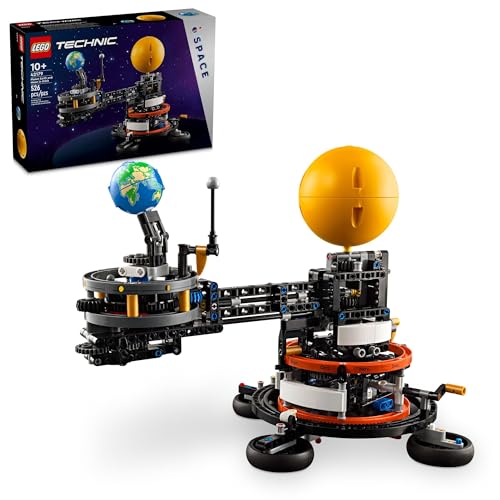
- Turn the crank to see the model's Earth and Moon move around the Sun
- Explore months, moon phases, and seasons through a hands-on build
- Create a working space display with a builder aged ten or older
A Tube That Waited Nearly Fifty Years
NASA has experience keeping Moon samples safe until better tools are available. On March 23, 2022, curators opened Apollo 17 sample 73001 after decades in storage.
Astronauts had sealed it in a vacuum on the Moon. Back on Earth, another protective tube and cabinets filled with nitrogen helped keep outside material away from it.
NASA had set aside some Apollo samples so future scientists could study them with methods that did not yet exist. Its account of opening sample 73001 explains how that careful storage created a new chance to study the Moon.
The sample was opened for other research, not this alien-particle proposal. But it shows why a sample's history matters. If scientists find something unusual in a grain, they need to know what could have touched or mixed with it along the way.
Inside NASA’s Lab as a Sealed Moon Sample Is Opened
Old Dust, New Questions
NASA's Apollo Next Generation Sample Analysis program studies preserved Moon material, including sealed and cold-stored samples. The work helps scientists learn about the Moon and plan future sample collection.
The alien-technology proposal asks whether a similar collection could answer another question: has anything made by a distant civilization reached the Moon?
Before that question can be tested on the scale proposed, researchers need a practical way to prepare, sort and check an enormous number of tiny grains.