

Capturing Bigfoot Review: The Lost Reel That Could Crack a 60-Year Mystery
You've probably seen the grainy footage: a supposed Bigfoot crosses a creek bed, turns toward the camera, and keeps walking into the trees. Roger Patterson filmed that famous walk in 1967, and people have been arguing over whether he captured an animal or a man in a costume ever since.
In Capturing Bigfoot, director Marq Evans returns to the dispute with a separate reel that spent decades in a Washington family's safe. His 2026 documentary also brings in Patterson's son, whose account of his parents gives the mystery a much more painful side.
Evans takes a while to get the story moving. But once Patterson's son describes what happened when he challenged his father's Bigfoot story, the documentary becomes well worth watching.
Spoiler note: This review discusses the new footage and the documentary's central claims.
The Original 1967 Bigfoot Film
Roger Patterson was a Bigfoot enthusiast from Washington. His friend Bob Gimlin was a cowboy and horse trainer, and the two men headed into Northern California in October 1967 to look for the creature.
The men said they spotted Bigfoot near Bluff Creek. Patterson operated the camera while Gimlin watched the supposed Bigfoot walk across the creek bed. The recording became known as the Patterson-Gimlin film.
The famous sequence lasts about a minute and includes that glance back at the camera. To believers, the footage shows a real animal. To skeptics, it shows someone wearing a suit. That disagreement has kept a very short piece of film under scrutiny for nearly 60 years.
The Reel in Norm Johnson's Safe
For decades, Norm Johnson kept a reel of Bigfoot footage locked in his family’s safe. So how was Norm connected to Roger Patterson, and why did he have the footage?
Norm worked with film for a living, developing it at Boeing before becoming manager of the company’s film department. Norm’s brother, Dave Johnson, worked at a print shop in Yakima, Washington.
Roger Patterson had written a book about Bigfoot sightings and footprints called Do Abominable Snowmen of America Really Exist?, published in 1966. According to Norm’s daughter, Teresa Brooks, Patterson met Dave when he came to the print shop to have that book printed.
Dave then introduced Patterson to his brother Norm, according to Ray Bricker, Norm’s longtime friend. Through Dave, Patterson now knew someone who worked professionally with film.
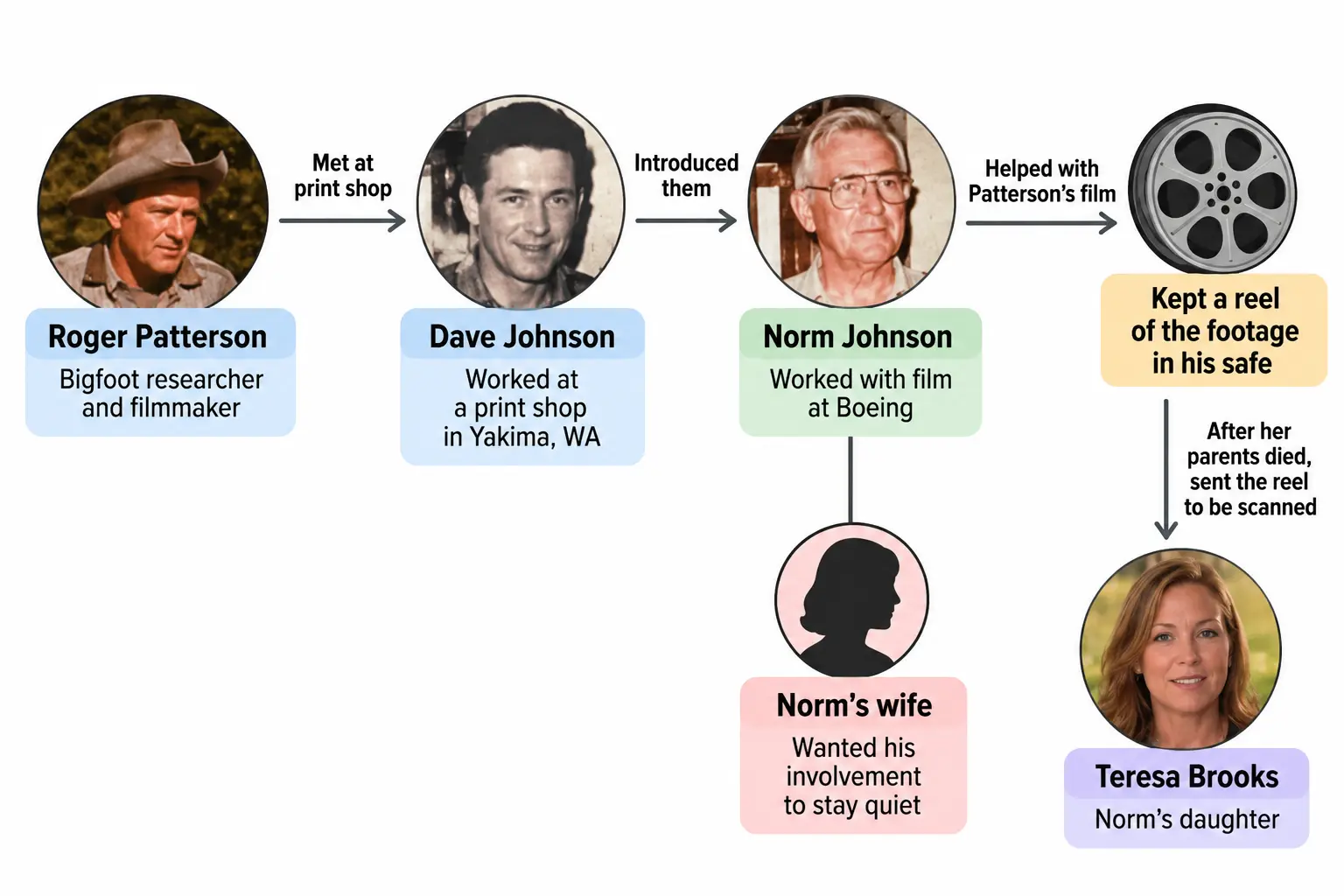
Bricker says Norm helped Patterson with his film and later told him he had kept a reel instead of returning it to Patterson. But Bricker’s account doesn’t explain exactly what that help involved. It doesn’t establish whether Norm edited the footage, developed it, or did something else.
Teresa believes her father locked the reel away because her mother wanted his involvement kept quiet. Her mother feared Norm could get into trouble, and Teresa thinks keeping the footage hidden was his way of reassuring her.
After both parents died, Teresa sent the reel to Costco to have it copied to DVD. In 2022, she contacted Olympic College’s film program, as she told the Kitsap Sun. Her message reached director Marq Evans, who arranged a clearer scan.
The reel showed a separate Bigfoot scene in a different setting. It wasn’t another copy of the famous 1967 Patterson-Gimlin footage.
Another Bigfoot, Another Look Back
According to Evans, the Johnson reel has some striking similarities to the 1967 footage. The supposed Bigfoot walks from left to right and looks back toward the lens. At that moment, the shaky camera steadies.
As Evans explained to Kitsap Smokestack, those familiar movements suggest a possible practice run for the famous shoot. If he's right, Patterson's 1967 film captured a rehearsed performance in a Bigfoot costume.
But the timing isn't settled. Bill Munns, a makeup and special-effects artist who examined the reel, says its film stock was made in 1966. That doesn't prove when the scene was filmed, so an earlier rehearsal remains Evans's theory.
Clint Patterson Challenges His Father's Story
Roger Patterson's son, Clint, gives the documentary its strongest story. His mother, Patricia Patterson, was Roger's widow, and Clint says she told him the original 1967 footage had been staged.
Clint says she disowned him when he wanted to speak publicly. His account of the letter she sent him is the movie's hardest moment. Roger had died in 1972, so the break left Clint estranged from his surviving parent.
Clint still calls his father his hero. He can believe the 1967 Bigfoot film was a hoax and love the man who made it, which makes his interviews all the more compelling.
The Man Who Says He Wore the Suit
Bob Heironimus, a Yakima man who knew Patterson and Gimlin, offers a more direct explanation of the famous walk. He says he wore the Bigfoot costume and never received the $1,000 he was promised.
Gimlin continues to reject the hoax claim. In his account, he and Patterson encountered a real creature at Bluff Creek.
The documentary also gives the footage's defenders their say. Anthropologist Jeff Meldrum sees signs of muscles moving beneath the supposed Bigfoot's fur. Munns draws on his experience with creature costumes to argue that a suit from 1967 couldn't explain what Patterson's camera recorded.
Those competing accounts come together uncomfortably when Clint and Heironimus approach Gimlin at a Bigfoot gathering. The encounter feels like an ambush, even if you're inclined to believe the two men challenging him. It's hard to watch someone being put on the spot, whatever you think of his story.
A Slow Start With a Strong Finish
The documentary takes too long to get going. Between Heironimus's costume story, Gimlin's denial, and the experts' arguments about what the camera recorded, there's a lot to keep straight. Those competing accounts sometimes make the investigation harder to follow than it needs to be.
But Clint's family story makes the wait worthwhile. By the ending, the argument over a creature on film has become a story about what happened when a son challenged his father's legacy. That's a much stronger reason to keep watching than another round of costume disputes.
The movie runs about an hour and 40 minutes. As of October 25, 2026, it is available to rent or buy on Prime Video in the US and Canada.
I liked Capturing Bigfoot, slow start and all. The Johnson reel, Clint's family story, and Heironimus's account settled the argument for me: I'm convinced the Bigfoot in the original 1967 Patterson-Gimlin film was a hoax. Case closed.

- A 16mm reel hidden in a safe reopens the 1967 footage.
- Roger Patterson's son Clint tells his story on camera.
- Part mystery, part family drama, from SXSW 2026.
The Age of Disclosure Puts UFO Secrecy in the Spotlight
Disclosure Day Movie Review and Ending Explained