

UFOs and Aliens in the Bible: Ancient Passages Explained
The Bible has more unexplained things in the sky than most UFO documentaries.
Wheels inside wheels, a chariot made of fire, a star that stops over a house, and a prophet who leaves the planet in a whirlwind.
Read those scenes with a modern imagination and it's hard not to picture craft, beams and visitors.
So it's no surprise that "are there aliens in the Bible?" is one of the oldest questions in UFO culture. What is surprising is who has taken it seriously, from a NASA engineer to the Vatican's own astronomer.
The question didn't come out of nowhere, though. It came out of a bestseller.
Why UFO Fans Keep Opening the Bible
The idea that ancient scripture might record visitors from the sky took off in 1968, when Erich von Däniken's Chariots of the Gods? asked whether the "gods" of old texts were astronauts.
Ezekiel was his star witness, and the prophet has been on the stand ever since.
The appeal is easy to understand. The Bible was written in an ancient world, but a few of its scenes feel cinematic, aerial and strangely technical.
So the better question isn't just whether aliens appear in it. It's why these passages keep sounding like contact stories to modern ears.
Start with the most famous one, a vision by a canal in Babylon.
Ezekiel's Wheels
Around 593 BC, a young priest in exile named Ezekiel was among his fellow captives by the Kebar canal in Babylon when, in his words, the heavens opened.
What he saw fills the first chapter of his book: a storm wind, flashing fire, four living creatures with four faces each, and beside them the wheels.

Each one looked like "a wheel intersecting a wheel." Their rims were full of eyes, and they could move in any of four directions without turning.
Above it all sat a throne like sapphire, with a figure on it that glowed like metal in a furnace.
Ancient readers understood this as the glory of God arriving in a foreign land. Ancient-astronaut readers see a witness struggling to describe a machine.
The most famous of those readers had the credentials to make people listen. Josef F. Blumrich was a NASA engineer who set out to disprove von Däniken's Ezekiel theory.
Instead, by his own account, the engineering details won him over. His 1974 book The Spaceships of Ezekiel rebuilds the vision as a landing craft, and he even patented an omnidirectional wheel inspired by the prophet's description.
You don't have to buy the spaceship to see why the passage grips people. Ezekiel reads like a man reaching for words that hadn't been invented yet.
Elijah's Chariot of Fire
Second Kings gives UFO readers another unforgettable exit.
The prophet Elijah and his apprentice Elisha are walking and talking when a chariot of fire and horses of fire drive between them. Then Elijah goes up to heaven in a whirlwind.
Elisha is left holding his master's cloak, staring at an empty sky.
To ancient readers, fire, horses and whirlwind were the language of divine power. To modern alien readers, the scene can feel like a fiery pickup.
The text doesn't sound ordinary either way. It's strange, visual and vertical, which happens to be the exact shape of a modern abduction story.
The Pillar of Cloud and Fire
The book of Exodus adds a slower, stranger image: a guide that never leaves.
As the Israelites cross the wilderness, a pillar of cloud leads them by day and a pillar of fire by night. When Pharaoh's army closes in, the pillar moves behind the camp and stands between the two sides all night.
For biblical readers, that's the visible presence of God on the march. For ancient-astronaut readers, it's an aerial object shepherding a migration.
Either way, a moving column in the sky is exactly the kind of scene that makes a UFO fan stop and reread.
The Star of Bethlehem
Matthew's Gospel describes Magi from the east following a star to the newborn Jesus.
This star does more than shine. It "went ahead of them until it stopped over the place where the child was."
Stars don't normally stop, which is why the passage has collected so many explanations: a rare conjunction of planets, a comet, a nova, a miracle.
UFO-minded readers notice something else. Whatever it was, it behaves like a guided light rather than a fixed point in the sky.
That's what keeps the Star of Bethlehem on the ancient-mystery shelf, right beside Ezekiel.
Angels: Messengers From Above
Angels complicate the alien question, because they don't look like one thing.
In Genesis, three visitors share a meal with Abraham and look like ordinary men. In Isaiah, the seraphim have six wings, and in Ezekiel the creatures beside the wheels come with faces, wings and fire.
The word itself, angelos in Greek and mal'akh in Hebrew, simply means messenger. And the pattern of a messenger visit is oddly familiar.
A being arrives from above, and people are so terrified that its first words are usually "do not be afraid." The visitor delivers its message and leaves.
Swap the robes for a jumpsuit and you have the structure of a modern encounter story. Researcher Jacques Vallée, one of the field's most influential thinkers, built a whole book on that overlap by setting UFO reports beside older accounts of visitors from the sky.

- Explore parallels between older folklore and modern UFO encounter accounts
- Read Jacques Vallee's influential approach to the history of contact stories
- Compare reports across eras instead of treating every case in isolation
Whether that means the same thing has been visiting under different names, or that humans describe the unknown in the same shapes every century, is the real argument.
Genesis 6 and the Nephilim
Genesis 6 is one of the strangest short passages in the Bible, and it's only four verses long.
The "sons of God" take human wives, and the Nephilim appear: "the heroes of old, men of renown."
Who were the sons of God? Some traditions read them as heavenly beings, while others read them as rulers, warriors or a human lineage.
The ancient Book of Enoch, which never made it into most Bibles, ran with the first reading. Two hundred angels called Watchers descend, marry human women and father giants.
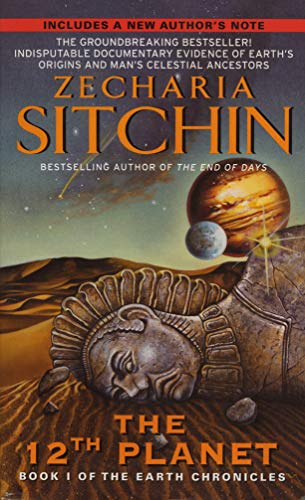
- Read the ancient-astronaut interpretation behind Sitchin's Nibiru narrative
- Explore ideas that strongly influenced later Anunnaki and alien-origin stories
- Evaluate the author's argument directly rather than through secondhand summaries
Ancient-alien writers love this passage because it reads like a hybrid story. It's the door through which giants, alien bloodlines and lost pre-flood history enter UFO lore, and our guide to the beings reported in alien lore shows how far that idea traveled.
Why Ancient Texts Sound Like Technology
Modern readers bring modern images with them.
Say "wheels" and we picture machinery; say "fire" and we picture propulsion; say "cloud" and we picture exhaust.
Ancient writers worked with a different symbolic toolkit. Storms, fire, wings, thrones, mountains, clouds and wheels all carried religious meaning long before anyone had seen an engine.
That doesn't make the passages boring. It makes them layered.
The same chapter can be read as scripture, as literature, as a mystery and as cultural memory, all at once. The spaceship reading is simply the newest layer.
Can Faith and Alien Life Share a Sky?
The Bible isn't a catalog of every living thing in the universe. Its subject is God, humanity, creation, covenant and the meaning of history.
That leaves plenty of room for cosmic questions, and some very official people have asked them.
In May 2008, the director of the Vatican Observatory, Father José Gabriel Funes, wrote in the Vatican's own newspaper that searching for extraterrestrial life doesn't contradict belief in God. The headline read "Aliens Are My Brother."

- Mysterious crop circles appear on a family's farm, and the familiar landscape begins to feel threatening.
- Small sounds and glimpses at the edge of the frame turn a quiet farmhouse into an unsettling place to spend the night.
- Choose this fictional first-contact thriller when you want suspense that builds before anything steps into view.
Many believers would treat life elsewhere as one more part of creation. Others would ask harder questions about theology, salvation and whether a non-human intelligence has its own spiritual story.
That tension is exactly why the topic refuses to go away.
So, Are Aliens in the Bible?
The Bible never uses the words alien, spacecraft or planet. What it has instead are visions and encounters that feel bigger than ordinary human experience.
Ezekiel's wheels feel mechanical, and Elijah's chariot feels aerial. The Star of Bethlehem feels guided, and the Nephilim feel like a door into a lost world.
Read them as a believer, a skeptic or a UFO fan, and you'll land in the same place: humanity's oldest stories about the sky are stranger than most people remember. Keep a Bible next to your UFO books, because the two have been talking to each other for a very long time.
Wonders in the Sky Review: Ancient UFO Reports Before 1879
David Icke’s Reptilian Theory: Claims, Origins & Evidence