
BAASS and AAWSAP: The $22 Million Contract Behind the Pentagon’s UFO Program
- Who's Who: The Cast in One Table
- Where Did the $22 Million Come From?
- What Does the Contract Actually Say?
- Invisibility Cloaks and Wormholes: The 38 Papers
- How Did Skinwalker Ranch Get Into a Defense Contract?
- Why Does AATIP Keep Coming Up?
- What Was KONA BLUE?
- How Can You Follow the Documents Yourself?
- So, What Did $22 Million Buy?
Follow the money in most UFO stories and you hit a dead end. Follow it here and you hit a contract number, an aerospace billionaire, and a ranch where the investigators chased reports of shadow figures.
Between 2008 and 2012, the Defense Intelligence Agency paid a private company to think about the future of aerospace, and the company thought about a great deal more.
The paper trail includes 38 research reports, a senator's letter asking for extra secrecy, and a follow-up pitch to Homeland Security under the code name KONA BLUE.
It also includes enough acronyms to make your eyes cross, so we'll take them one at a time, starting with the cast.
Who's Who: The Cast in One Table
Every name here gets confused with at least one other, so keep this scorecard handy:
| Name | Who or what it is |
|---|---|
| DIA | The Defense Intelligence Agency, the Pentagon's intelligence arm and the customer. |
| AAWSAP | Advanced Aerospace Weapon System Applications Program (the exact wording varies): the DIA program that held the money. |
| BAASS | Bigelow Aerospace Advanced Space Studies: Robert Bigelow's company, the contractor that did the work. |
| AATIP | Advanced Aerospace Threat Identification Program: a second name for the same effort, later reused for an informal follow-on. |
| Skinwalker Ranch | A Utah property Bigelow owned, famous for paranormal reports, where the contractor sent investigators. |
| KONA BLUE | The proposal to restart the work under Homeland Security after the DIA cancelled it. |
| AARO | The All-domain Anomaly Resolution Office, the Pentagon office that reviewed all of this in 2024. |
Now, the money.
Where Did the $22 Million Come From?
From the Senate, and specifically from Harry Reid of Nevada, then the majority leader. With support from Senators Ted Stevens and Daniel Inouye, he steered $22 million into the defense appropriations for fiscal years 2008 and 2010.
On paper, the job was to assess "long-term and over-the-horizon foreign advanced aerospace threats."
The DIA official who set up and ran the program was James Lacatski. He had read Hunt for the Skinwalker, the book about Bigelow's earlier investigations at the ranch, and visited the property himself; that contact is what led to the funding.
The Black Vault's releases even include a letter from Lacatski to Bigelow dated June 19, 2007, on DIA letterhead, more than a year before any contract was signed. Which brings us to the paperwork.
What Does the Contract Actually Say?
The released DIA contract is number HHM402-08-C-0072, awarded on September 22, 2008. It incorporates a BAASS proposal dated September 3, 2008, and runs a base year through September 2009 with an option year after that.
The DIA released it in June 2023, six pages with the sensitive bits blacked out, five years after John Greenewald of The Black Vault asked for it. BAASS was Bigelow's company but far from his only UFO venture, as our Robert Bigelow profile explains.
The statement of work lists 12 areas of future aerospace technology, such as advanced lift, propulsion, unconventional materials, and signature reduction. Investigating UFOs, AARO notes, was not spelled out in it.
Those 12 areas produced the papers that made this story famous.
Invisibility Cloaks and Wormholes: The 38 Papers
The deliverables were Defense Intelligence Reference Documents, or DIRDs: 38 of them, produced through BAASS and stamped with DIA cover pages. Two are worth a click for the titles alone.
One is Invisibility Cloaking: Theory and Experiments, dated March 2010. The other is Traversable Wormholes, Stargates, and Negative Energy, dated April 2010.
You can see why UFO readers' eyes light up. A commissioned paper, though, is useful precisely when a concept has big obstacles, because the agency wants to know what would be required and what stands in the way.
So a study tells you the question was asked, not that a device exists. AARO's 2024 review adds that the papers "were never thoroughly peer reviewed."
The DIA released 37 of the 38 in March 2022; the lone holdout, a paper on high-energy laser weapons, remains classified. Papers were the official product, and Utah was the unofficial one.
How Did Skinwalker Ranch Get Into a Defense Contract?
Skinwalker Ranch is a 512-acre property in Utah's Uintah County with a long reputation for lights, creatures, and things that don't behave. Bigelow bought it in 1996 and sold it in 2016; the History channel's The Secret of Skinwalker Ranch followed in 2020.
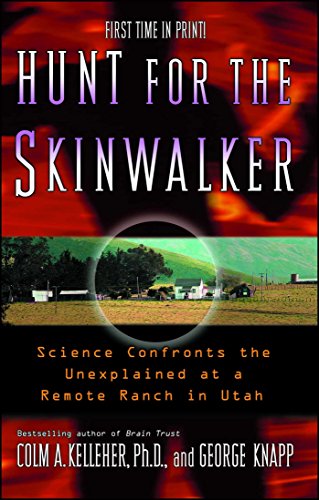
- Follow the ranch investigation in a full-length account coauthored by George Knapp
- Explore the reported events behind one of UFO culture's most discussed locations
- Compare the investigators' interpretations with the claims covered in the article
While AAWSAP ran, the ranch belonged to Bigelow, the head of the contractor. According to AARO's 2024 historical report, the contractor investigated it as "an alleged hotspot of UAP and paranormal activity," examining reports of "shadow figures" and "creatures" and exploring "remote viewing" and "human consciousness anomalies."
It even planned to hire psychics to study "inter-dimensional phenomena" believed to appear there. Subtle, it was not.
The same report says the contractor reviewed new cases and old Project Blue Book files, ran debriefing teams, and proposed labs to examine any recovered materials. All of it had the support of the DIA program manager, AARO says, though the agency itself never sought or authorized it.
The insiders tell it with more relish: Lacatski, Bigelow scientist Colm Kelleher, and Las Vegas reporter George Knapp published Skinwalkers at the Pentagon in October 2021, and our George Knapp profile covers Knapp's long history with the ranch.
So why do most people know this program by a different name?
Why Does AATIP Keep Coming Up?
Because for years, hardly anyone had heard of AAWSAP. The name that hit the headlines on December 16, 2017, when the New York Times, Politico, and the Washington Post all ran the story of a secret Pentagon UFO program, was AATIP.
The same reporting brought short videos of Navy jets chasing something they couldn't identify, the footage at the heart of our Nimitz Tic Tac article.
AARO's report says the two names were "used interchangeably," including on official documents, but that AATIP "was never an official DoD program." After AAWSAP was cancelled, the label lived on with an informal group inside the Pentagon who looked into military sightings on the side, with no dedicated staff or budget.

- Explore Richard Dolan's chronology of UFO reports and government secrecy claims
- Place individual encounters within a longer period of Cold War history
- Use a detailed historical volume to follow up on cases that brief articles can only introduce
There's a secrecy subplot too: on June 24, 2009, Reid asked Deputy Secretary of Defense William Lynn to make the program a Special Access Program, and Lynn declined on the advice of James Clapper, then the Pentagon's intelligence chief. When two accounts of AATIP seem to disagree, check the dates and the people first.
That story ended, officially, in 2012. Unofficially, its supporters went looking for a new home.
What Was KONA BLUE?
AARO says the DIA terminated AAWSAP in 2012, once the deliverables were in, over concerns about the project. Its supporters then pitched the Department of Homeland Security on a new version under a code name: KONA BLUE.

- Get a broad introduction to the cases and debates that shape UFO research
- Connect historic sightings with more recent questions about secrecy and disclosure
- Choose subjects for deeper reading from a guide covering the wider UFO mystery
The released KONA BLUE records are the advocates' sales pitch: the earlier papers, a database, investigations, and a request for a Prospective Special Access Program. The plan would restart UAP investigations, continue the paranormal research, and reverse-engineer any recovered off-world craft the team hoped to acquire.
Senators Lieberman and Reid asked for the program to be established, and it got some traction at DHS before leadership rejected it "for lacking merit." AARO adds that no craft or bodies were ever collected; their existence was assumed by the people writing the proposal.
AARO also says interviewees described KONA BLUE as a compartment hiding "non-human biologics," the same term David Grusch later used in Congress. One document assesses a past effort while another argues for a proposed one, which is why summaries of this history put the emphasis in such different places.
How Can You Follow the Documents Yourself?
1. Start With the Contract
The Black Vault's AAWSAP archive gathers the releases along with the request history. Read the contract first so the stranger papers have a setting.
2. Pick a Type of Document
A DIRD examines a concept, case material concerns reported observations, and a proposal explains what its authors wanted next. Knowing which one you're holding stops a speculative calculation from turning into a test report.
3. Then Read AARO Beside the Insiders
AARO's report is the government's own look back, and it doesn't pull punches. Read it beside Skinwalkers at the Pentagon and you'll see the same facts arranged into two very different stories.
So, What Did $22 Million Buy?
Thirty-eight papers on the physics of the far future, a field program at the strangest ranch in Utah, and a paper trail that runs straight into today's UFO debate.
Nothing in the public record shows a recovered craft or a working wormhole. What it shows is a funded DIA–BAASS relationship that wandered a long way from its statement of work.
If the acronyms scared you off before, keep the contract number in your pocket. HHM402-08-C-0072 is where every one of these threads can be tied down.
Robert Bigelow and His Decades of UFO Research
What Did David Grusch Mean by 'Biologics'?