
Roswell Declassified: A Reader’s Guide to What’s Actually in the Files
- First, What Happened in July 1947?
- Who Asked for the Files?
- The Two Records That Date From 1947
- What Was Project Mogul Supposed to Explain?
- Why Did the Air Force Write a Second Report About Bodies?
- What Happened to the Records That Are Gone?
- Is the Guy Hottel Memo Part of Roswell?
- Which Report Should You Open First?
- So, What's Actually in the Files?
Officially, Roswell was explained in 1947, explained again in 1994, and explained one more time in 1997, which tells you how well the first explanation went over.
In between, a congressman sent government auditors hunting for every record of the crash, and they came back with two documents from 1947 and a note about files that no longer exist.
Add an FBI memo about three-foot bodies in metallic cloth, and you have a paper trail far more fun than "declassified documents" suggests.
You don't need a clearance to read any of it, just a sense of which file answers which question.
Let's open them one at a time, starting with the week that produced them.
First, What Happened in July 1947?
Roswell Army Air Field in New Mexico was home to the 509th Bomb Group, and in early July 1947 a rancher named "Mac" Brazel turned up at the sheriff's office with odd debris from his land: rubber strips, tinfoil, tough paper, and sticks.
On July 8, the base's public information office announced that it had recovered a "flying disc," and the Roswell Daily Record reported that the RAAF had captured a flying saucer. The very next day, the commanding general of the Eighth Air Force in Fort Worth, Roger Ramey, said the men had actually picked up a radar-tracking weather balloon.
Officially, that version held for decades. For the full saga, see our Roswell UFO incident article; here, we're following the paper.
Who Asked for the Files?
In 1993, Congressman Steven Schiff of New Mexico started asking the Defense Department about Roswell and worried he wasn't getting everything. So he turned to the General Accounting Office, the auditors who work for Congress, and asked them to find every government record of the crash.
The Air Force searched too, after Secretary of the Air Force Sheila Widnall freed anyone with knowledge of the events from their old security obligations. The result was the July 1994 Report of Air Force Research Regarding the Roswell Incident.
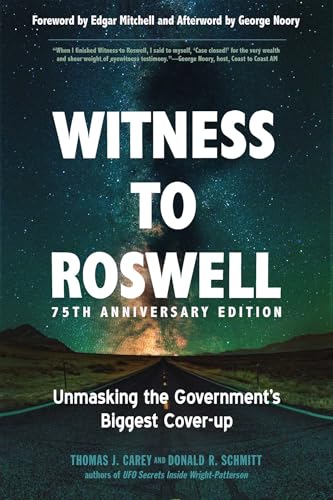
- Explore the Roswell witness accounts assembled by Thomas Carey and Donald Schmitt
- Follow the authors' case for a cover-up in one extended investigation
- Compare their interpretation with the official explanations and records discussed in the article
The auditors' own report followed on July 28, 1995, after a sweep of Defense Department, FBI, CIA, and National Security Council records. What they found that actually dates from 1947 fits on two pages.
The Two Records That Date From 1947
1. The Base's Own July 1947 History
The combined history of the 509th Bomb Group and the base for July 1947 notes that the public information office "was kept quite busy … answering inquiries on the 'flying disc.'" It adds, flatly: "The object turned out to be a radar tracking balloon."
The base's commanding officer signed it as a complete and accurate account.
2. The FBI Teletype of July 8, 1947
The same day as the press release, the FBI's Dallas office teletyped headquarters and its Cincinnati office. An Eighth Air Force official had phoned to report the recovery, as the GAO summarizes it, of "a hexagonal-shaped disc suspended from a large balloon by cable."
The disc and balloon were headed to Wright Field in Ohio for examination, the object resembled a high-altitude weather balloon with a radar reflector, and the FBI was doing no further investigation. So the Bureau's only 1947 record is the military saying "balloon" and the Bureau saying "fine."
What neither record explains is what kind of balloon, and that's where the 1990s reports come in.
What Was Project Mogul Supposed to Explain?
The Air Force's 1994 research and the fuller 1995 volume, The Roswell Report: Fact Versus Fiction in the New Mexico Desert, gave the balloon a name: Project Mogul. The volume bundles Colonel Richard Weaver's report with a balloon-research synopsis by Lieutenant James McAndrew.
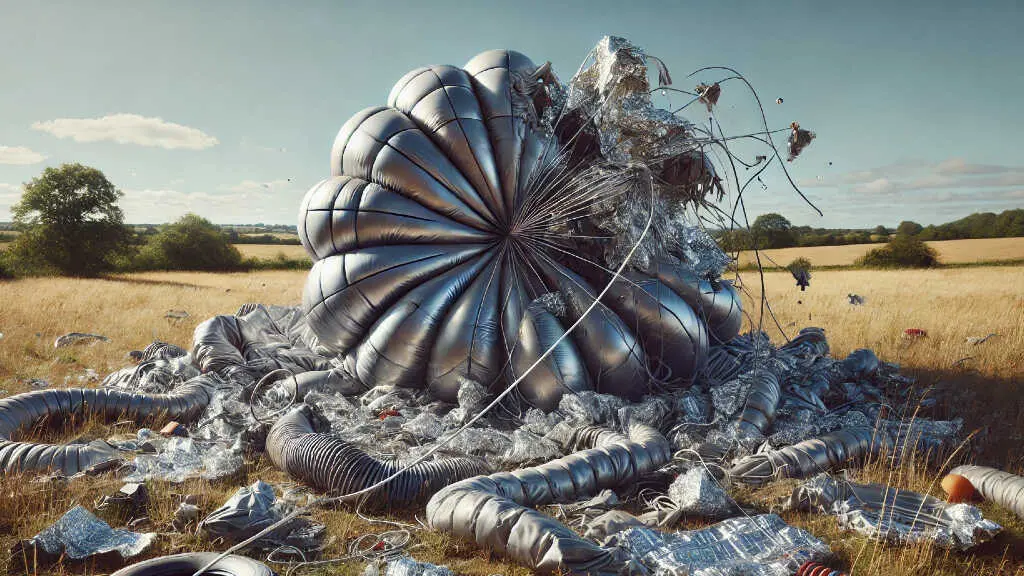
Mogul, in the GAO's words, was "a highly classified U.S. effort to determine the state of Soviet nuclear weapons research using balloons that carried radar reflectors and acoustic sensors." In plain English: balloon trains carrying microphones aloft to listen for Soviet atomic tests.
That fixes something the plain "weather balloon" line never did. The hardware could be ordinary rubber, foil, and sticks, exactly as Brazel described, while the reason for flying it was a secret worth keeping.
You don't need exotic material for a purpose to be classified. The report builds its case from records and interviews; judging it means following how those connect to the debris.
That handled the wreckage. It did nothing for the stories about bodies.
Why Did the Air Force Write a Second Report About Bodies?
By the 1990s, witnesses were describing small bodies, and a balloon can't explain those. So in 1997 the Air Force published The Roswell Report: Case Closed, written by McAndrew, the same officer who did the balloon research.
Its answer: the "aliens" were probably anthropomorphic test dummies dropped from high-altitude balloons. Between June 1954 and February 1959, it says, 43 balloon flights carried 67 dummies over New Mexico for projects called High Dive and Excelsior.
The hospital stories, it argues, blend two real tragedies: a 1956 KC-97 crash that killed 11 airmen and a 1959 balloon accident that injured two pilots. Notice the dates.
Every one of those events happened years after July 1947, so the report isn't saying dummies fell at Roswell; it's saying memories of the 1950s got folded into a story about 1947. That makes chronology the whole ballgame: when was an account first recorded, what date did it give, and could a later event fit?
The title says closed; the fine print is where the disagreement lives.
What Happened to the Records That Are Gone?
Now for the part that launched a thousand forum threads. The GAO found that the base's administrative records from March 1945 through December 1949, and its outgoing messages from October 1946 through December 1949, had been destroyed.
The disposal form doesn't say who destroyed them, when, or under what authority. That's a real gap, and it's easy to see why it sounds like a cover-up.

- Explore Richard Dolan's chronology of UFO reports and government secrecy claims
- Place individual encounters within a longer period of Cold War history
- Use a detailed historical volume to follow up on cases that brief articles can only introduce
The same report adds context:
- It was common: the chief archivist at the National Personnel Records Center said many Air Force records from that era were destroyed without citing the governing authority, and the base's 1950 messages went the same way.
- They were routine categories: finance, supplies, buildings and grounds, and general administration.
- No crash report was required: Army rules in 1947 demanded permanent reports for air accidents, but not for a balloon.
The CIA searched all its databases for "Roswell, New Mexico" in 1995 and came up empty. So the absence is real, but a gap can't tell you what used to fill it.
It leaves a records question, not an answer about the debris.
Is the Guy Hottel Memo Part of Roswell?
On March 22, 1950, Guy Hottel, special agent in charge of the FBI's Washington Field Office, sent a one-page memo to J. Edgar Hoover. It relayed a story told to an agent by a third party, who said an Air Force investigator had reported three "flying saucers" recovered in New Mexico.
Quoting the memo, they were "circular in shape with raised centers, approximately 50 feet in diameter," each holding "three bodies of human shape but only three feet tall, dressed in metallic cloth of a very fine texture." The memo ends by noting that "no further evaluation was attempted."
When the FBI launched its online Vault in April 2011, some outlets reported the memo as proof of a Roswell crash, and it racked up nearly a million views in two years. The Bureau's own explainer gently points out a few things:
- It isn't new: it was first released publicly in the late 1970s.
- It isn't 1947: it's dated nearly three years after Roswell, with no reason to connect the two.
- It was never investigated: the FBI calls it "simply a second- or third-hand claim."
- It might echo a hoax: some think so, though the Bureau's files can't confirm it.
The memo is a genuine record of a rumor reaching an official, which is different from the rumor being true. The FBI's own sign-off: "Sorry, no smoking gun on UFOs."
Which Report Should You Open First?
That depends on which part of Roswell brought you here:
| Document | What it tries to answer |
|---|---|
| Air Force, Fact Versus Fiction (1995) | What the debris was, via Project Mogul. |
| GAO records search (1995) | Which records survive and what happened to the rest. |
| Air Force, Case Closed (1997) | Where the stories about bodies came from. |
| Guy Hottel memo (1950) | A saucer rumor the FBI wrote down and never checked. |
Pick the debris report for the balloon reconstruction, the GAO search for the archive question, or Case Closed for the body accounts. Treat them as one big official statement and you'll lose the thread.
So, What's Actually in the Files?
Official reporting from 1947, two attempts to explain the incident, one unverified memo, and a gap in the archive. No document in the set describes a recovered craft or crew.

- Read Corso's account of alleged recovered technology in his own book
- Explore a major influence on modern crash-retrieval and reverse-engineering stories
- Compare the memoir's claims with the historical record and other Roswell accounts
The argument hasn't stopped, either: crash-retrieval claims were back before Congress in 2023, when David Grusch testified about alleged recovered craft, a year after UFOs got their first hearing in half a century.
Open the file that matches your question, read the pages that answer it, and enjoy the rare pleasure of a mystery with footnotes.
Roswell UFO Incident: Crash, Cover-Up, and Alien Legend
David Grusch UFO Claims: Non-Human Craft, Biologics, and Congress