
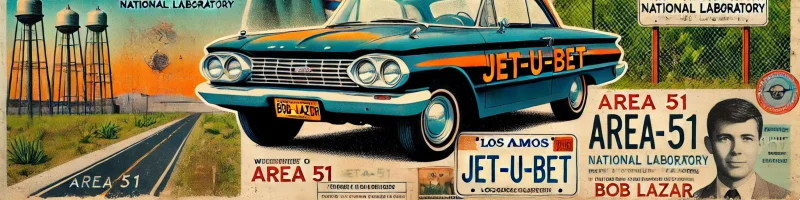
Bob Lazar and Area 51: The Man Who Says He Worked on Nine Flying Saucers
Bob Lazar's alleged job came with an unusual problem: the machine was already built, but nobody had handed him an instruction manual. He said he was supposed to help work out how a recovered flying saucer operated.
That's the claim that brought him onto Las Vegas television in 1989. Appearing at first under the name Dennis, he told reporter George Knapp about work at a secret facility near Area 51.
The account had more than a mysterious craft. Lazar described the journey to work, the briefings, and the equipment waiting for him when he arrived.
It's those details that make his story so easy to picture. Let's follow them from the flight into the desert to the questions that are still attached to the job.
Where Did Lazar Say He Worked?
Lazar appeared anonymously on KLAS in May 1989, then publicly under his own name that November. He described a facility called S-4 near Papoose Lake, south of Area 51.
In a November 21, 1989 radio interview, he said he flew into Groom Lake and took a bus farther south. Area 51 was a stop along the way, rather than the place where he said the craft were kept.
Once there, he described reading briefing material before working with the equipment. Even this supposed encounter with alien technology began with catching up on the paperwork.
That distinction between Area 51 and S-4 can get lost in retellings. The famous name is convenient shorthand, but Lazar's account depends on the separate installation he described beyond it.
What Do We Know About Area 51?
Area 51 is a real restricted flight-test facility. Its history includes classified American aircraft development, such as the work described in the CIA's account of the U-2's first flight.
So secret aviation work in this part of Nevada isn't an invention. It's an established part of the setting.
The recovered-craft facility Lazar called S-4 is another claim, however. Confirming Groom Lake doesn't establish the alleged hangars farther south or what he said was inside them.
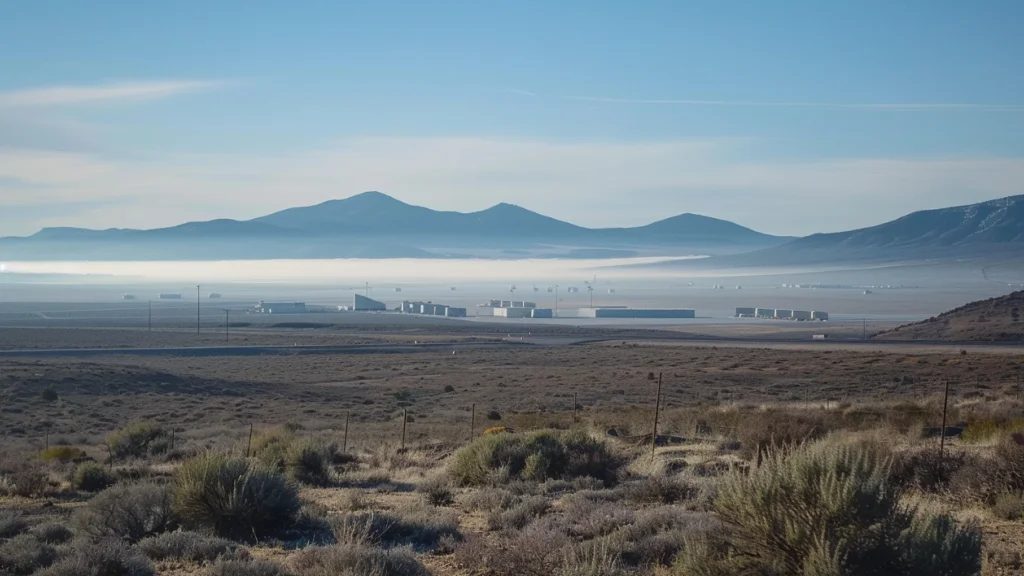
For that part of the story, we're back with Lazar's description. And one particular craft gets most of the attention.
What Was the Sport Model?
Lazar said S-4 held nine craft. The one he described in detail was a compact disc he called the Sport Model, a surprisingly everyday name for something supposedly built elsewhere in the universe.
He described a smooth exterior and an interior arranged for occupants smaller than adult humans. The seats and spaces gave listeners something more specific to picture than a light in the sky.
They also gave artists enough information to create models. These reconstructions illustrate his account; they aren't independently documented vehicles.
Lazar said briefing material connected the craft with Zeta Reticuli. The system already had a place in UFO lore through Betty Hill's star map, as our Zeta Reticuli and ZR3 article explains.
Even in his own account, that origin was something he'd read about. It wasn't a journey he said he'd taken or a destination he'd independently established.
How Was the Craft Supposed to Work?
Lazar described his assignment as reverse engineering. That means starting with a finished device and working backward to understand how it functions.
You can see why the setup appeals to UFO audiences. The craft is supposedly right there, but the people examining it have to work out what each part does.
In Lazar's propulsion account, a reactor used element 115 and worked with a system that manipulated gravity. This was meant to explain movement beyond what an ordinary jet or rocket could manage.
He also described a workplace where information was tightly divided. Someone assigned to propulsion wouldn't necessarily know what other teams were doing.
That helps explain the limits of the account he gave, but it also leaves much of the wider story dependent on what he said he was told or allowed to read.

- Explore a visual reconstruction of the S-4 facility where Bob Lazar says he worked on recovered craft.
- Hear Lazar's account alongside interviews with George Knapp, the reporter who brought his story to the public.
- A compelling next watch if Area 51's alleged technology and unanswered questions keep pulling you back.
Didn't Scientists Later Discover Element 115?
They did. Element 115 is now called moscovium, with the symbol Mc, and has its place on IUPAC's periodic table.
This is one of the details that keeps bringing people back to Lazar. He used the number years before scientists successfully made the element.
But the number itself describes a nucleus with 115 protons. Scientists could discuss that target before producing it, just as they could discuss other elements that hadn't yet been made.
The Royal Society of Chemistry's moscovium entry describes highly radioactive material produced in tiny quantities. That work didn't deliver the stable fuel or the gravitational effects in Lazar's story.
Our element 115 timeline follows the dates behind the comparison. The isotope guide explains why a different neutron count might change an atom's lifetime without automatically giving it the other claimed properties.
What Does His Background Tell Us?
A jet-powered car is an unusual item to find in an employment debate. In Lazar's case, a 1982 newspaper story about his car became one of the recurring pieces of his public paper trail.
That report, along with a laboratory directory entry, supports a connection to Los Alamos. The laboratory's official history explains why an association with it mattered to a story about advanced scientific work.
Those records don't establish every claim about Lazar's position. A directory entry isn't a full personnel file, and a newspaper description doesn't verify a university degree.
A 1996 interview published by investigator Tom Mahood adds an acquaintance's recollection of Lazar as a technically capable contractor. The source wasn't named publicly, limiting independent checks on that account.
Lazar's claims of advanced study at MIT and Caltech remain publicly unsubstantiated. Suggestions that records were erased need supporting evidence too.
It's possible to recognize practical technical ability without treating it as confirmation of a particular qualification or secret job. Those are different parts of the background story.
Other recovered-technology accounts, including Philip J. Corso's, gave readers more stories in a similar vein. They don't supply the missing records for Lazar's alleged work.

- Read Corso's account of alleged recovered technology in his own book
- Explore a major influence on modern crash-retrieval and reverse-engineering stories
- Compare the memoir's claims with the historical record and other Roswell accounts
Why Does the Story Keep Reaching New Audiences?
Knapp's interviews gave the account its early platform. Jeremy Corbell's 2018 documentary, Bob Lazar: Area 51 & Flying Saucers, brought another major presentation of the story to viewers.
The descriptions have also become increasingly easy to visualize. An April 2026 discussion of S4: The Bob Lazar Story focused on filmmaker Luigi Venditelli's reconstruction of the environment Lazar described.
A detailed model can help you understand where the rooms, equipment, and craft are supposed to fit. It doesn't give the filmmaker independent access to the original facility.
That matters when a reconstruction looks convincing enough to feel like a visit. You're seeing the account illustrated, with the original question about the place still attached.
Has Lazar's S-4 Job Been Confirmed?
The public record hasn't established that Lazar reverse-engineered extraterrestrial craft at S-4. His account sits alongside a real history of secret aviation work, but the connection to that particular job is still missing.
An authenticated program record or a testable sample with a documented history could help make it. Demonstrating the claimed propulsion would answer a bigger question again.
For now, that's where the story leaves us: with a remarkably detailed description of an extraordinary workplace, and no independently established route through its doors.
Bob Lazar and Element 115: How Did He Know?

George Knapp: UFO Reporter, Bob Lazar, Area 51, and Skinwalker Ranch