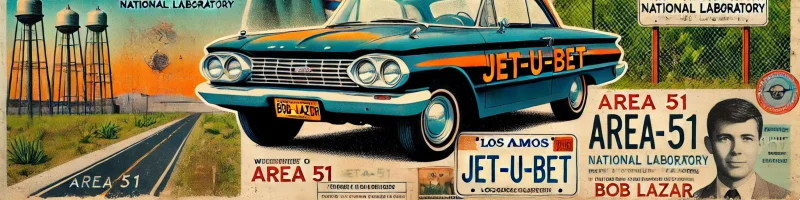
Bob Lazar and Element 115: How Did He Know?
Bob Lazar's fans have one card they love to play, and it's a number: 115.
In 1989, Lazar told a Las Vegas TV audience that a stable, super-heavy element 115 powered the flying saucers he'd worked on in the Nevada desert.
Fourteen years later, scientists made element 115 for real. Today it sits on the periodic table under the name moscovium.
So, case closed? Did a guy from Las Vegas scoop the world's physicists?
Not quite, and the wobble starts with what Lazar actually claimed the stuff could do.
What Did Lazar Say About Element 115?
Lazar's claim is that he worked at S-4, a hidden facility near Area 51, helping to reverse-engineer a recovered alien craft. The full Bob Lazar and Area 51 story has the bus ride, the hangars and the missing job records.

- Read Bob Lazar's account of S-4 and his alleged work on unusual propulsion
- Go beyond interview clips with a book-length version of his story
- Compare the memoir with reporting, disputed details, and later retellings
Element 115 was his answer to the obvious question: what makes the thing go?
In a December 1989 interview with KLAS-TV reporter George Knapp, he laid it all out. Element 115, he said, "is a stable element," a super-heavy material that Earth's labs couldn't make because that "would just take an infinite amount of power and an infinite amount of time."
Inside the craft's reactor, he claimed, the 115 "under bombardment with protons lets out an anti-matter particle." That gives you "a hundred percent conversion of matter to energy," plus a gravity wave the craft can bend to its will.
And where do you get such a thing? Lazar's guess: "somewhere maybe on the fringes of a supernova," or near a binary star system.
That's quite a résumé for one element. Stable, plentiful enough to fuel a fleet, and a gravity generator on the side.
Hold onto those three claims. They matter far more than the number does.
Wait, How Do You Name an Element That Doesn't Exist?
Here's the handy thing about atomic numbers: they're just a proton count.
"Element 115" means a nucleus with 115 protons. You don't need a sample on your desk to describe that combination, any more than you need a finished house to write down its address.
Physicists had been talking about superheavy elements for decades before Lazar. The idea of an "island of stability," a pocket of longer-lived heavy nuclei, dates back to the 1960s.
Lazar's own line about elements "113 to 116" becoming stable again is that idea, repeated on television. He didn't pluck 115 out of thin air; it was already on the physics wish list.
You can see the target in writing. Lawrence Livermore's January 2002 research magazine reported that its scientists had "begun efforts to add elements 115 and 113 to the periodic table" and were shipping 22 milligrams of americium-243 to Russia for the job.
That report came 13 years after Lazar's interviews, so it can't tell us where he got the idea. It does show that naming an element comes long before making one.
When Was Element 115 Actually Discovered?
If you've heard that Lazar "predicted" something discovered in 2016, there's a chunk of the story missing.
Here's the real timeline:
| Year | What Happened |
|---|---|
| 1989 | Lazar goes on Las Vegas TV and names element 115 as the saucer fuel. |
| 2002 | Livermore announces plans to make elements 115 and 113 with the Dubna lab in Russia. |
| 2003 | A summer of experiments at Dubna produces the first four atoms of element 115. |
| 2004 | The results are published. |
| 2010–2013 | A larger set of experiments makes the atoms that satisfy the official referees. |
| 2015 | IUPAC formally credits the discovery in December. |
| 2016 | Element 115 becomes moscovium, symbol Mc, in November. |
The Livermore announcement has the details of that first run. Between July 14 and August 10, 2003, the team fired calcium-48 at an americium-243 target and caught four atoms of element 115.
Four atoms. Not four grams, not four pounds, four atoms, each surviving 30 to 80 milliseconds before falling apart.
Even that wasn't enough for the rulebook. IUPAC's 2015 decision credits experiments that began in 2010 and were confirmed in 2012 and 2013, which is why some references list the discovery year as 2010.
The name arrived in November 2016, honoring the Moscow region that's home to the Dubna institute. So 2016 is the christening, not the birth.
Whichever year you pick, Lazar said the number first. The question is whether he described the right stuff.
Was the Real Thing Anything Like His Fuel?
Let's put the two side by side.
| Lazar's element 115 | Real moscovium | |
|---|---|---|
| Stable? | "It's a stable element." | Radioactive; atoms last a fraction of a second. |
| How much? | Enough to run a reactor. | "Only a few atoms have ever been made." |
| Made where? | The fringes of a supernova. | A cyclotron in Dubna, Russia. |
| Day job | Antimatter reactor and gravity drive. | "At present, it is only used in research." |
The quotes on the right come from the Royal Society of Chemistry's moscovium entry. Our element 115 guide explains how scientists even spot atoms that vanish that quickly.

- Learn the human stories behind discoveries in chemistry
- Make unfamiliar elements more memorable through accessible historical accounts
- Add real scientific context to reading about element 115 and exotic materials
The number matches. Nothing else does.
Lazar's fuel has to sit in a reactor and take a steady beating from protons. Moscovium can't survive long enough to be bombarded with anything.
What If Scientists Made the Wrong Isotope?
This is the comeback you'll hear most often: maybe the lab made a different version of element 115.
In chemistry, a "different version" means a different isotope. Same 115 protons, different number of neutrons, and that mix can change how long a nucleus survives.
It's a fair point, and it's exactly what the island of stability is about. Scientists really are hunting for neutron counts that make superheavy nuclei last longer.
But "lasts longer" is measured against a fraction of a second. Even the optimistic predictions describe a radioactive material, not a fuel rod you could keep on a shelf.
And a longer lifetime says nothing about antimatter or gravity waves. Those would need their own experiments, and nobody has run them.
So the isotope idea keeps the door open a crack. It doesn't put a saucer in the hangar.
So, Did Lazar Predict Element 115?
He said the number before anyone made the atoms. That part is true, and it's the whole reason this debate exists.
But the number was already a known target, and the material that eventually turned up behaves nothing like the fuel he described. Stable, plentiful and gravity-bending it is not.
The idea has certainly had a good run. It even has a video-game cousin in X-COM's Elerium-115, an alien fuel players spend the whole game hunting for.
What would change the picture is simple: an authenticated sample that does what Lazar says. Until one shows up, element 115 is a great story with a very small punchline, roughly four atoms wide.
Element 115: The Real Element Behind the Flying Saucer Fuel Story
Bob Lazar and Area 51: The Man Who Says He Worked on Nine Flying Saucers