

Element 115: The Real Element Behind the Flying Saucer Fuel Story
- What Is Element 115?
- How Do You Make an Element From Scratch?
- Why Was It Called Ununpentium?
- Can You Buy a Piece of Moscovium?
- How Did Element 115 Become UFO Fuel?
- Where Did Lazar Say the Fuel Came From?
- Did Lazar Predict the Discovery?
- Could Another Version Last Longer?
- Does the Discovery Back Up Lazar's Story?
Somewhere in a Russian lab in the summer of 2003, four atoms popped into existence and were gone again in well under a second. They've been at the center of a flying-saucer argument ever since.
Those atoms were element 115, the square on the periodic table now known as moscovium.
A Las Vegas man named Bob Lazar had been calling it the fuel of the flying saucers since 1989, fourteen years before anyone managed to make it.
So is the real thing anything like the stuff he described?
That question has a surprisingly precise answer, and it starts with what the number 115 actually means.
What Is Element 115?
Deep inside an atom sits a nucleus, a tiny core of protons and neutrons. Count the protons and you know which element you're dealing with.
Put 115 of them together and you have element 115. Its official name is moscovium, its symbol is Mc, and it lives in group 15, period 7 of the periodic table.
The Royal Society of Chemistry's moscovium page sums it up as "a highly radioactive metal, of which only a few atoms have ever been made." As product descriptions go, that one won't sell many bottles.

- Put recognizable images beside the names and symbols of chemical elements
- Make the periodic table easier to explore through a visual presentation
- Build a scientific reference point for reading about unusual materials and elements
Radioactive means the nucleus doesn't sit still; it decays into something else, and fast.
One more wrinkle: atoms with the same 115 protons can carry different numbers of neutrons, and those versions, called isotopes, can have very different lifetimes.
Hold that thought, because it becomes the heart of the alien-fuel debate later. First, a more basic question: how do you make an atom that doesn't exist?
How Do You Make an Element From Scratch?
You can't mine moscovium, because there isn't any lying around. Scientists have to build it by slamming two smaller nuclei together and hoping they stick.
The arithmetic is the easy part. Calcium brings 20 protons, americium brings 95, and 20 plus 95 is 115.
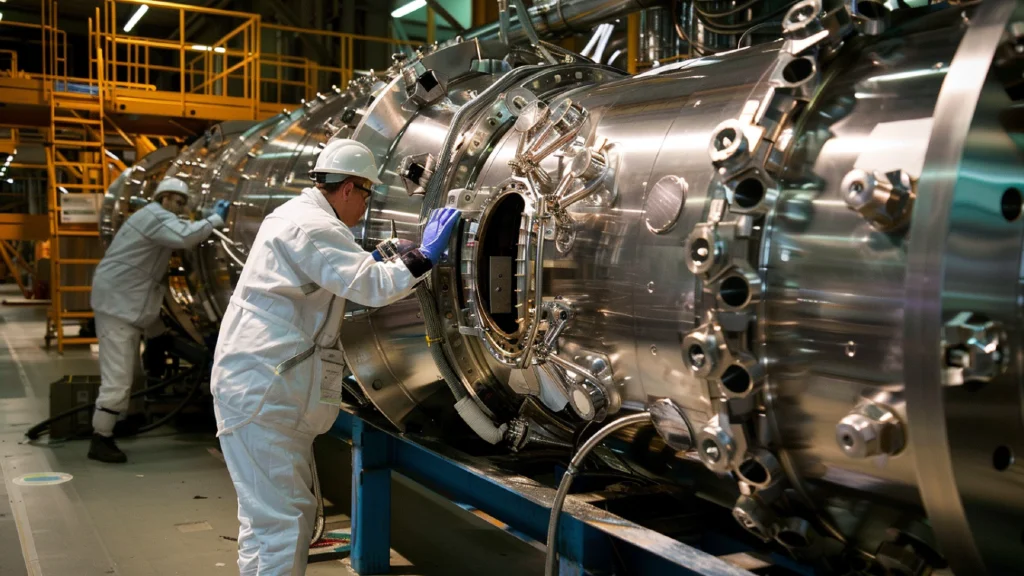
The hard part needs a very particular machine: the Joint Institute for Nuclear Research in Dubna, in the Moscow region, runs a cyclotron that can fire an intense beam of calcium-48, while Lawrence Livermore National Laboratory in California supplied the americium-243 target.
Between July 14 and August 10, 2003, the team ran that beam into the target. Out of all those collisions came four atoms of element 115, according to Livermore's announcement.
Nobody got a shiny lump to hold up for the cameras. The atoms survived just 30 to 80 milliseconds, according to Livermore's account of the experiment, then fell apart.
Three of the four atoms left the same trail: five alpha decays in under 30 seconds, ending in a dubnium nucleus with a comfortable 16-hour half-life. The results were published in Physical Review C in February 2004.
The Dubna–Livermore discovery account puts that run in context: fifteen years of experiments with the same separator produced six new elements, numbers 113 through 118. Four atoms and a set of detector readings, and the periodic table had a new square.
A new square needs a name, though, and that took a while.
Why Was It Called Ununpentium?
If you've run into ununpentium or Uup in an older article, you haven't found a different substance. Those were the placeholder name and symbol, built from the digits one, one and five.
Placeholders hang around because naming is slow: a discovery has to be confirmed beyond reasonable doubt before anyone can propose a name. The International Union of Pure and Applied Chemistry, the body that referees the periodic table, credited the discovery in December 2015, after a bigger run of experiments that began in 2010.
Then, on June 8, 2016, IUPAC proposed the name moscovium, honoring the Moscow region that's home to the Dubna institute. After a five-month public comment period, the name became official on November 30, 2016.
Here's how the labels fit together:
| Name | What It Means |
|---|---|
| Element 115 | Any nucleus with 115 protons. |
| Ununpentium or Uup | The temporary name and symbol, retired in 2016. |
| Moscovium or Mc | The permanent name and symbol. |
| Elerium 115 | The fictional fuel in the X-COM games, borrowed from the same number. |
The label changed. The proton count didn't, and neither did the supply.
Can You Buy a Piece of Moscovium?
Sadly for anyone completing an element collection, moscovium doesn't come in little sample bottles.
Scientists make a handful of atoms at a time, and each one is gone before you could blink. Nobody has ever assembled a chunk you could weigh, polish or put on a shelf.
Even its melting point, color and density have to be predicted from theory, because there has never been a visible piece to measure. The Royal Society of Chemistry is blunt about its day job: "At present, it is only used in research."

- Learn the human stories behind discoveries in chemistry
- Make unfamiliar elements more memorable through accessible historical accounts
- Add real scientific context to reading about element 115 and exotic materials
Even its lifetime needs careful wording. Scientists use half-life, the time it takes for roughly half of a large group of identical nuclei to decay, and for moscovium-288 that's around 0.09 seconds.
All of which makes the next part of the story remarkable. In 1989, a man in Las Vegas said he'd worked with a stable chunk of the stuff.
How Did Element 115 Become UFO Fuel?
Bob Lazar was an unknown name until 1989, when he sat down with KLAS-TV investigative reporter George Knapp. He said he'd worked at S-4, a hidden site near Area 51, helping to reverse-engineer a recovered alien craft.
Element 115, Lazar told Knapp, "is a stable element," and making it on Earth "would just take an infinite amount of power and an infinite amount of time."
He described the reactor as "a plate about 18 inches in diameter with a sphere on top," with a chip of 115 inside. Bombard that chip with protons, he said, and it released antimatter, delivering "a hundred percent conversion of matter to energy."
The 115 also set up a gravitational field that the craft siphoned off and amplified, and Lazar said 2.2 pounds of it held the energy of "47 10-megaton hydrogen bombs."
A pound of it, he added, would be about "the size of a plum." You can read the whole exchange in the 1989 interview transcript.
Stable, plentiful and gravity-bending: that's a big résumé for one element. So where did Lazar say it came from?
Where Did Lazar Say the Fuel Came From?
Not from any lab on Earth. The only place 115 could form, Lazar told Knapp, was "somewhere maybe on the fringes of a supernova or somewhere around maybe a binary star system."
So the fuel arrived with the craft. When he retold the story on Joe Rogan's podcast in 2019, Lazar said the stable 115 "absolutely came with the craft."

- Explore a visual reconstruction of the S-4 facility where Bob Lazar says he worked on recovered craft.
- Hear Lazar's account alongside interviews with George Knapp, the reporter who brought his story to the public.
- A compelling next watch if Area 51's alleged technology and unanswered questions keep pulling you back.
The craft's origins got stranger, too. Lazar said he remembered that at least one of them "was part of an archaeological dig," adding, "So it's old."
His memoir, Dreamland, tells the whole story at book length.
A supernova-forged fuel inside an ancient craft is quite a package. It's also a package that four atoms in Dubna put to the test.
Did Lazar Predict the Discovery?
The dates are what make this so tempting. Lazar named element 115 in 1989, and scientists made it in 2003.
But atomic numbers don't have to wait for a discovery. "Element 115" just means a nucleus with 115 protons, and you can describe that combination long before anyone builds one.
Lazar said as much himself in 1989, noting that "science today theorizes that up around Element 113 to 116" the elements "should again become stable." The number was already on the physicists' wish list; he didn't pluck it from the air.
Our Bob Lazar and element 115 timeline has every date; the short version is that the number matched and the material didn't:
- Lifetime: Lazar's fuel was stable; the Dubna atoms lasted 30 to 80 milliseconds.
- Quantity: a plum-sized pound versus four atoms.
- Source: the fringes of a supernova versus a cyclotron in the Moscow region.
- Day job: an antimatter reactor and gravity drive versus "only used in research."
Knowing a number and knowing the properties of a usable material are separate things. That gap is where the next argument lives.
Could Another Version Last Longer?
Maybe you've heard of the island of stability. It's a real idea in nuclear physics, and it sounds tailor-made for a substance that needs to stop falling apart.
For half a century, theorists have predicted that nuclei with around 114 protons and 184 neutrons would outlive their neighbors. Lawrence Livermore's guide to superheavy-element research describes the hope of finding half-lives "longer than the millisecond timescale," maybe long enough to do chemistry with.
Here's the catch. "Stable" in this corner of physics means more stable than the alternatives, and a longer-lived isotope could still be radioactive and brutally hard to make.
The element 115 stability question digs into what you'd have to change inside the atom. Even a huge improvement in lifetime wouldn't hand the material gravity-controlling powers; those would need their own measurements.
Does the Discovery Back Up Lazar's Story?
The experiments proved that element 115 exists. They didn't produce a stable fuel or demonstrate a propulsion system, and Lazar's version needs both.
Connecting the two would take an authenticated sample doing what he says it does. A shared number, however striking, can't make that connection for us.
Still, the real discovery has plenty going for it: a team built one of the heaviest nuclei ever made and caught it in the few milliseconds before it vanished. Element 115 is fascinating before anyone tries to put it in a flying saucer.
Bob Lazar and Element 115: How Did He Know?
Can Element 115 Be Stable? A Trip to the Island of Stability